How much are closing costs in Texas? For most buyers, the honest answer is somewhere between 2% and 5% of the home’s purchase price. On a $300,000 house, that works out to roughly $6,000 to $15,000 due at the closing table, and that is on top of your down payment.

A lot of first-time buyers in Houston and across the state focus so hard on saving for the down payment that the closing bill catches them off guard. It shouldn’t, and asking how much are closing costs in Texas early is half the battle. Once you know what goes into it, who normally pays what, and where you have room to negotiate, closing costs become one more line in your budget instead of a last-minute scramble. If you are still at the planning stage, our Houston Home Buyer’s Guide 2026 is a good place to start.
In this guide, we answer how much are closing costs in Texas by breaking down what you will actually be charged, show you real numbers, give you a printable-style checklist, and share seven practical ways to bring the total down.
How Much Are Closing Costs in Texas? Start with What They Are
Closing costs are the fees and prepaid expenses you pay to finish a home purchase. They are separate from the price of the house and separate from your down payment. Put simply, they are the missing piece when you ask how much are closing costs in Texas. Some go to your lender, some go to the title company that handles the closing, some go to third parties like the appraiser, and some are simply money you are setting aside in advance for things like insurance and property taxes.
In Texas, closings are typically run by a title company or escrow officer rather than an attorney. That company collects the funds, makes sure the title is clear, records the deed, and pays everyone who needs to be paid. Most of the fees you see on your final statement pass through them. That is where most of the answer to how much are closing costs in Texas comes from.
One thing that works in your favor: Texas has no state-level deed transfer tax, so you will not see that charge that buyers in some other states have to cover.
Average Closing Costs in Texas for Buyer: The Numbers
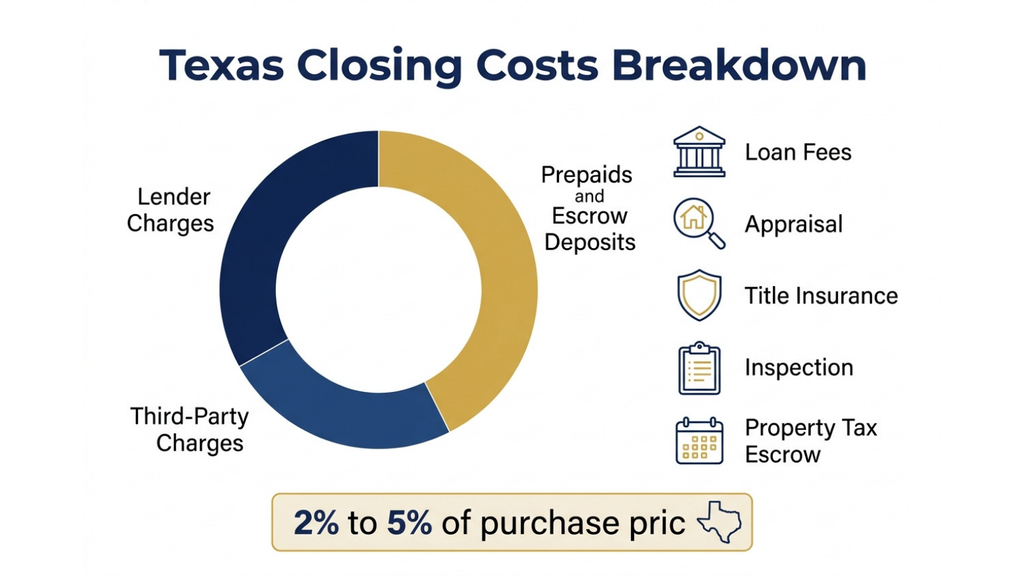
When people ask how much are closing costs in Texas, the average closing costs in Texas for a buyer usually fall between 2% and 5% of the purchase price. Where you land in that range depends on your loan type, your down payment, the county your home is in, the cost of homeowners insurance, and what you negotiate with the seller.
Here is a realistic picture of how much are closing costs in Texas, piece by piece. These are typical ranges, not quotes, and your own numbers will vary by lender and location.
| Cost Item | Typical Range | Who Usually Pays |
|---|---|---|
| Loan origination and lender fees | 0.5%–1% of the loan, plus processing and underwriting fees | Buyer |
| Appraisal | $500–$800 | Buyer |
| Home inspection | $400–$700 | Buyer |
| Survey | $400–$800 | Negotiable, often buyer |
| Lender’s title insurance | Set by state-regulated rates | Buyer |
| Owner’s title insurance | Set by state-regulated rates | Often seller under the standard contract, but negotiable |
| Escrow or settlement fee | A few hundred dollars up to about $1,000 | Often split or negotiated |
| Recording and misc. fees | Modest, usually under a few hundred dollars | Buyer |
| Prepaid homeowners insurance (first year) | Often several thousand dollars | Buyer |
| Property tax escrow deposit | Several months of taxes | Buyer |
| Prepaid interest | Varies with closing date | Buyer |
Notice how much of this is not really a “fee” at all. The insurance premium and the tax deposit are your own money, set aside so your lender can pay those bills on your behalf later. That is one reason the answer to how much are closing costs in Texas feels high compared with the national picture: homeowners insurance and property taxes here are both on the heavier side.
What Makes Up Closing Costs for Buyers in Texas
If you want to understand closing costs for buyers in Texas, it helps to sort them into three buckets.
1. Lender Charges
These are the fees for creating and processing your mortgage. The biggest is usually the origination charge, which commonly runs about half a percent to one percent of the loan amount. You will also see underwriting, processing, credit report, and flood certification fees. If you take out discount points to lower your interest rate, those get added here as well.
Government-backed loans add their own costs. FHA loans carry an upfront mortgage insurance premium, VA loans have a funding fee unless you are exempt, and USDA loans have a guarantee fee. Many buyers roll these into the loan, which keeps the cash due at closing lower but raises the loan balance.
2. Third-Party Charges
These go to the professionals who verify the house and the title. That includes the appraisal your lender orders, the title search and title insurance, the survey, and the escrow fee. In Texas, title insurance premiums are set by the state rather than negotiated company by company, so shopping on that line item will not save you much. The escrow fee and some other services are where you have more room.
Your home inspection is also paid by you, though it is technically a cost of deciding whether to buy, not a lender requirement. We always recommend one, and the inspection report is often the starting point for repair negotiations.
3. Prepaids and Escrow Deposits
This is where Texas buyers often get surprised. At closing you typically prepay your first year of homeowners insurance, fund an escrow account with several months of property taxes and insurance, and pay interest from your closing date through the end of that month. Because Texas property tax rates can run near 2% of a home’s value in many Houston-area locations, the tax deposit alone can be a serious number, and it is a big reason the answer to how much are closing costs in Texas varies so widely.
Who Pays Closing Costs in Texas: Buyer or Seller?
The short version is that both sides pay something, but the buyer carries more of the load. That split is a big part of the answer to how much are closing costs in Texas for any given purchase. Sellers mainly cover their agent commissions, any agreed repairs, and often the owner’s title policy under the standard Texas contract. Buyers cover most lender fees and prepaids.
The real answer is that almost everything is negotiable. Your offer can ask the seller to contribute toward your closing costs, and in a market where homes are sitting longer, sellers are often open to it. Our Houston real estate market report for 2026 shows how rising inventory is shifting that balance. These are called seller concessions, and lenders limit how much they will allow:
- Conventional loans: generally 3% of the price with a small down payment, 6% with 10% to 25% down, and 9% with more than 25% down.
- FHA loans: up to 6% of the price.
- VA loans: up to 4% in concessions, on top of other allowable seller-paid costs.
Those limits are worth checking with your lender before you write the offer, since concessions can change the real answer to how much are closing costs in Texas for you, because the rules vary by loan program and can change.
How Much Are Closing Costs in Texas on a $300,000 Home? A Real Example
Let’s answer how much are closing costs in Texas with real numbers. Say you are buying a $300,000 house in the Houston area.
- At 2%, you would owe about $6,000.
- At 3%, you would owe about $9,000.
- At 5%, you would owe about $15,000.
A buyer with a strong credit profile, a competitive lender quote, and a seller contribution might end up near the low end. A buyer with a high insurance premium, discount points, and no concessions will be near the top. The point is that when you ask how much are closing costs in Texas, you can plan with a range now and tighten it up once you have an official estimate.
That official estimate is the Loan Estimate your lender must send within three business days of your application. Then, at least three business days before closing, you will receive the Closing Disclosure with your final numbers. Compare the two line by line. If something jumped, ask why.
Texas Closing Costs Checklist for Homebuyers
Use this Texas closing costs checklist for homebuyers to make sure nothing sneaks up on you when you work out how much are closing costs in Texas for your own purchase. Go through it once when you start house hunting and again when you are under contract.
- Earnest money deposit: due shortly after your offer is accepted, and it is credited toward your closing costs or down payment.
- Option fee: the small fee that buys you the termination period in the Texas contract. It is separate from earnest money.
- Home inspection: schedule it during your option period.
- Appraisal: ordered by your lender, paid by you.
- Lender fees: origination, underwriting, processing, and any discount points.
- Title insurance and title search: confirm who is paying the owner’s policy.
- Survey: ask whether the seller has an existing survey you can use.
- Homeowners insurance: get quotes early, since this is often the biggest prepaid item.
- Property tax and insurance escrow: ask for the exact number of months required.
- Prepaid interest: depends on the day of the month you close.
- HOA fees: transfer fees, resale certificates, and any dues collected in advance.
- Final walkthrough and wire instructions: verify wiring details by phone with the title company, never by email alone.
7 Proven Ways to Lower Your Closing Costs in Texas
There is no magic trick, but there are real moves that can cut thousands from the answer to how much are closing costs in Texas. Here is what we walk our clients through.
1. Compare Loan Estimates from at Least Three Lenders
Two lenders can quote the same interest rate with very different fees. Ask each one for a Loan Estimate on the same day and compare the sections for origination charges and services you can shop for. This is the single easiest way to save. So how much are closing costs in Texas when you shop around? It can be less than the first quote you get.
2. Ask the Seller for a Contribution
Write seller concessions into your offer. In a balanced or buyer-friendly market, this is often a fair ask, especially if you are not pushing the price down as far as you could. Just confirm your loan type allows the amount you request.
3. Consider a Lender Credit
Some lenders will cover part of your closing costs in exchange for a slightly higher interest rate. This lowers your cash at closing but increases your monthly payment, so run the math on how long you plan to stay in the home before choosing it.
4. Time Your Closing Date
Prepaid interest is calculated from your closing day to the end of the month. Closing near the end of the month shrinks that bill. The tradeoff is that you will make your first mortgage payment sooner than someone who closed early in the month, so it helps cash flow now, not in total.
5. Shop the Services You Are Allowed to Shop
Your Loan Estimate will separate the services you can choose from the ones your lender picks. Inspections, surveys, and some title-related services can often be compared on price. Do not sacrifice quality on the inspection, though. A cheap inspection that misses a foundation issue costs far more than it saves.
6. Look into Assistance Programs
Statewide and local programs, including those through the Texas State Affordable Housing Corporation, offer down payment and closing cost assistance to eligible buyers. Income limits, credit requirements, and funding availability change, so check current details with a participating lender.
7. Scrutinize Your Closing Disclosure
Mistakes happen. Review every line of your Closing Disclosure the moment it arrives, ask about any fee you do not recognize, and make sure the numbers match your Loan Estimate. Questioning a vague “misc” charge is perfectly reasonable.
Common Mistakes Texas Buyers Make with Closing Costs
A few patterns come up again and again when buyers work out how much are closing costs in Texas.
- Budgeting only for the down payment. Always set aside cash for closing on top of it.
- Waiting too long to price insurance. Homeowners insurance quotes in Texas can vary a lot, and the number affects both your closing bill and your monthly payment.
- Assuming the seller pays everything. Concessions are possible, not automatic.
- Not asking about the survey. An existing survey can save you hundreds.
- Falling for wire fraud. Closing funds are a target for scammers. Always confirm instructions by calling a number you already trust.
Frequently Asked Questions
How much are closing costs in Texas for a first-time buyer?
First-time buyers asking how much are closing costs in Texas should plan for roughly 2% to 5% of the purchase price. Assistance programs and seller concessions can reduce the amount you bring to the table.
Are closing costs in Texas higher than in other states?
Not always. When comparing how much are closing costs in Texas with other states, the answer depends on more than fees. Texas skips the state transfer tax, but prepaid property taxes and homeowners insurance are often higher here, which pushes the cash needed at closing up.
Can I roll closing costs into my mortgage?
Sometimes. Certain loan programs let you finance specific fees, such as FHA upfront mortgage insurance. Lenders do not typically let you simply add all closing costs to the loan on a standard purchase, so ask your lender what applies to you.
Does the seller have to pay any closing costs?
Sellers usually pay their agent commissions and often the owner’s title policy under the standard Texas contract. Anything beyond that, including a contribution toward your costs, is negotiated in the offer.
Final Thoughts
So, how much are closing costs in Texas? Plan for 2% to 5% of the purchase price, understand the three buckets they fall into, and use the checklist and seven tips above to keep your number as low as possible. The earlier you start, the more control you have.
If you are buying in Houston or the surrounding area and want a clear, personalized estimate before you make an offer, we are here to help answer how much are closing costs in Texas for your exact home. Start by browsing our current Houston listings to see what fits your budget, then contact Mustafa Tunc today to walk through your numbers and build a plan that works for you.